Historic Markers Revisited
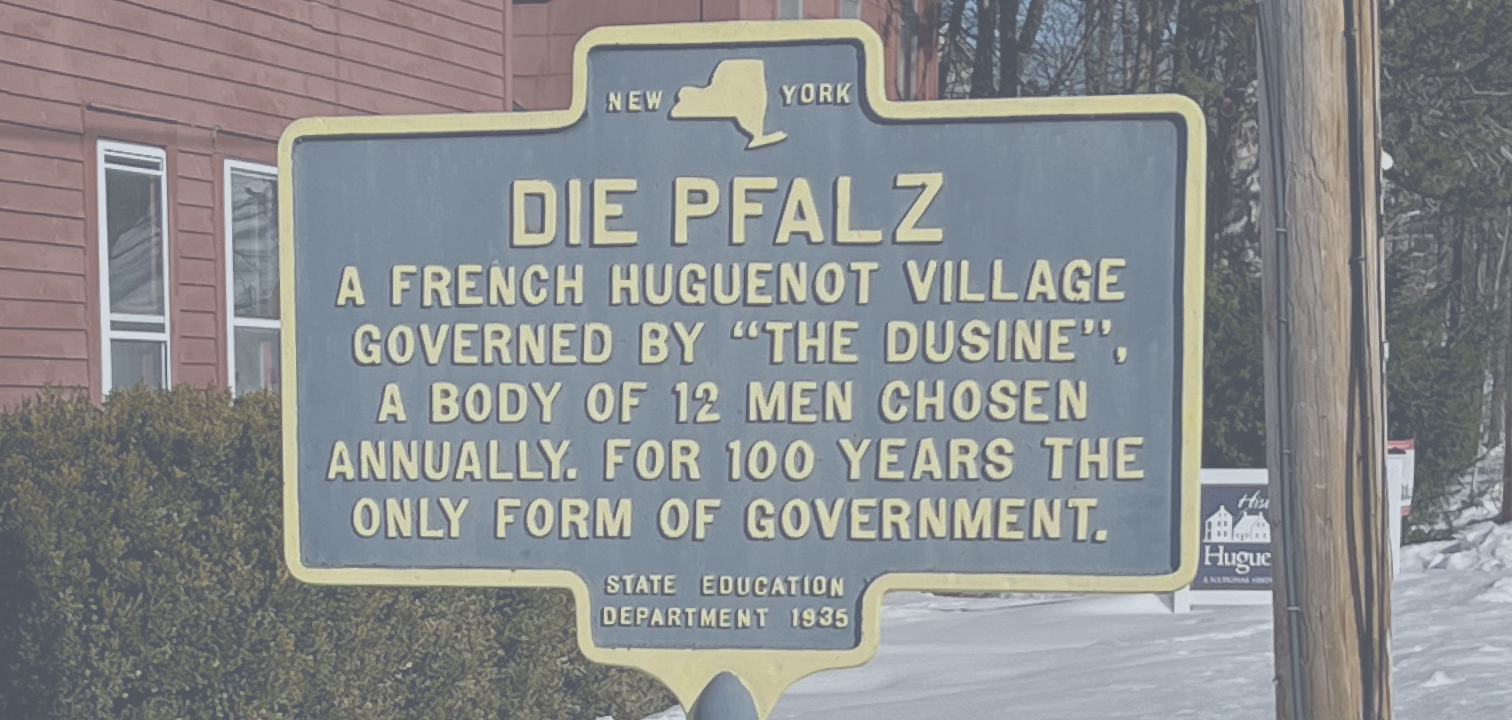
DIE PFALZ at Deyo Hall and Anna Banks House
(6 and 4 Broadhead Avenue)
A FRENCH HUGUENOT VILLAGE GOVERNED BY “THE DUSINE”, A BODY OF 12 MEN CHOSEN ANNUALLY. FOR 100 YEARS THE ONLY FORM OF GOVERNMENT.
-
“Die Pfalz” was the region in Germany where members of the first twelve families found temporary refuge from religious conflict in Europe.
-
Twelve French-speaking Protestant Huguenot and Walloon families from modern day northern France and Belgium made an agreement in 1677 with the Native Esopus people to settle on land that later became New Paltz.
-
The term “the Duzine” was coined by later historians in reference to the “Twelve Men,” a group established in 1728 to manage land divisions and guard against encroachment. A representative was chosen annually from each of the original twelve families.
-
A governing body of town officers existed separately from the early 1700s. The town was officially incorporated in 1785.
The “Twelve Men” was absorbed by the local government in 1828.
-
This building was originally two separate structures, the Anna Banks House (4 Broadhead Ave.) and Deyo Hall (6 Broadhead Ave.).
The Anna Banks House was built in 1894 by a Black builder, Jacob Wynkoop, hired by Anna Margaret Banks, a local Black woman. Though Anna never lived in the house, she rented it out until she sold it in 1911.
Learn more by downloading “Jacob Wynkoop: Building a Free Black Neighborhood” from our free walking tour mobile app.
Deyo Hall, the larger of the two buildings, was originally a glass factory built by Joseph Hinsberger in 1924. At the time, he lived next door with his family in the Anna Banks House.
In 1965 the former factory was acquired by HHS from the daughters of Joseph Hinsberger in honor of their father. It was then renovated and renamed Solomon LeFevre Deyo Hall. The Anna Banks House was acquired by HHS in 1974, and the two buildings were subsequently connected.
-
Description text goes here