Historic Markers Revisited
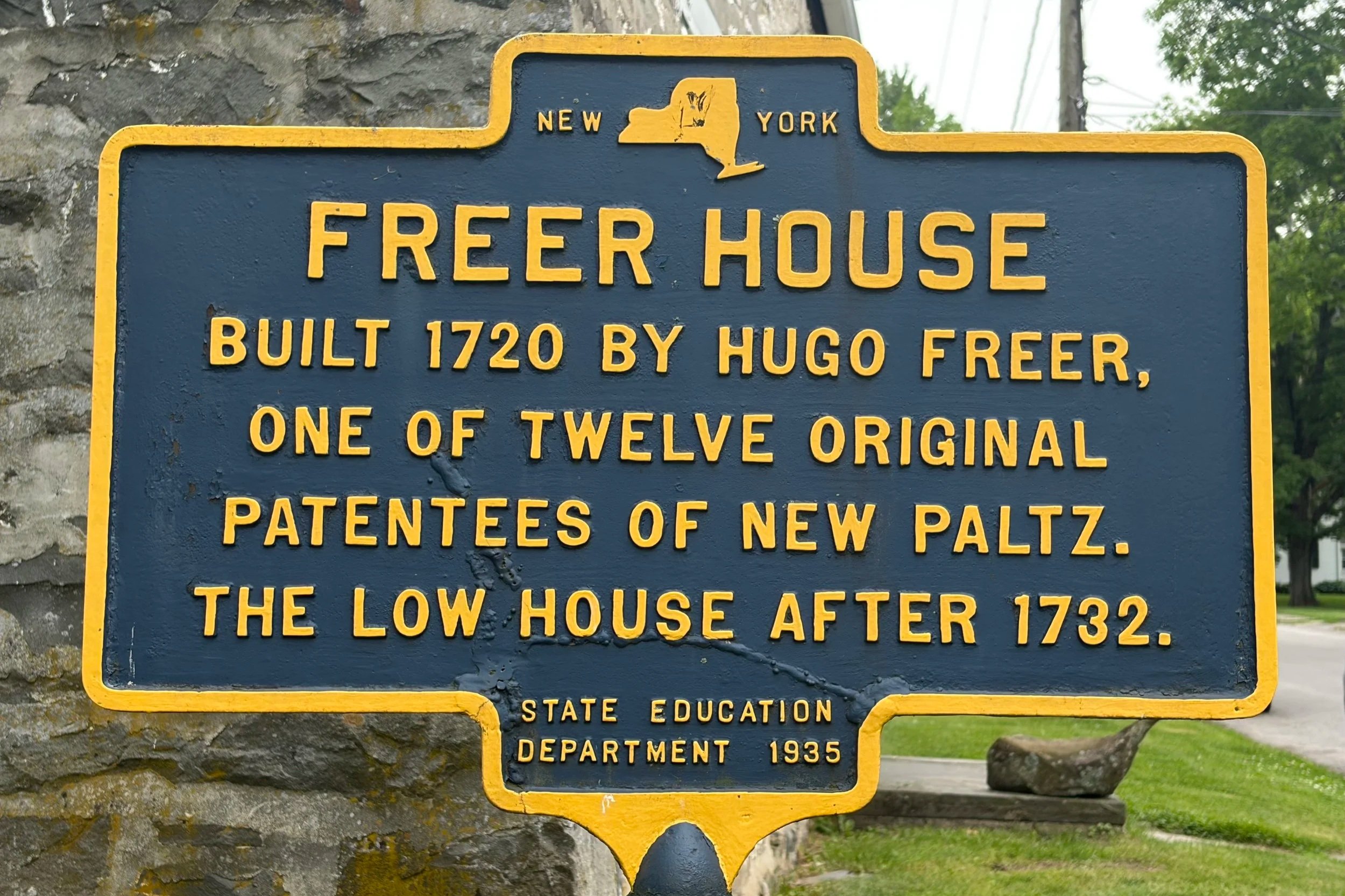
FREER HOUSE
Freer-Louw House - 98 Huguenot street
BUILT 1720 BY HUGO FREER, ONE OF TWELVE ORIGINAL PATENTEES OF NEW PALTZ. THE LOW HOUSE AFTER 1732.
[22.5% incorrect]
-
The current house is one of the last stone houses to be built in what has become the Huguenot Street National Historic Landmark District, followed only by the Ezekiel Elting House in 1799.
-
Rebecca acquired the homestead sometime after her father’s death in 1732. Rebecca and Johannes lived in the house with their adult son, Simeon, and his young family.
-
Hugo Freer (d. 1698) was among the last patentees to arrive in New York in 1676. Originally from Herly-en-Boulonois in what is now France, Freer relocated to die Pfalz [link to die Pfalz page] and married Marie Haye. She and their two daughters died there during the plague of 1665–66, leaving Hugo with only his son, also named Hugo. The elder Hugo married Jeanne Wibau the following year and had two more sons, Abraham and Isaac, before bringing his combined family to New York.
-
This building was originally two separate structures, the Anna Banks House (4 Broadhead Ave.) and Deyo Hall (6 Broadhead Ave.).
The Anna Banks House was built in 1894 by a Black builder, Jacob Wynkoop, hired by Anna Margaret Banks, a local Black woman. Though Anna never lived in the house, she rented it out until she sold it in 1911.
Learn more by downloading “Jacob Wynkoop: Building a Free Black Neighborhood” from our free walking tour mobile app.
Deyo Hall, the larger of the two buildings, was originally a glass factory built by Joseph Hinsberger in 1924. At the time, he lived next door with his family in the Anna Banks House.
In 1965 the former factory was acquired by HHS from the daughters of Joseph Hinsberger in honor of their father. It was then renovated and renamed Solomon LeFevre Deyo Hall. The Anna Banks House was acquired by HHS in 1974, and the two buildings were subsequently connected.