
Historic Markers Revisited
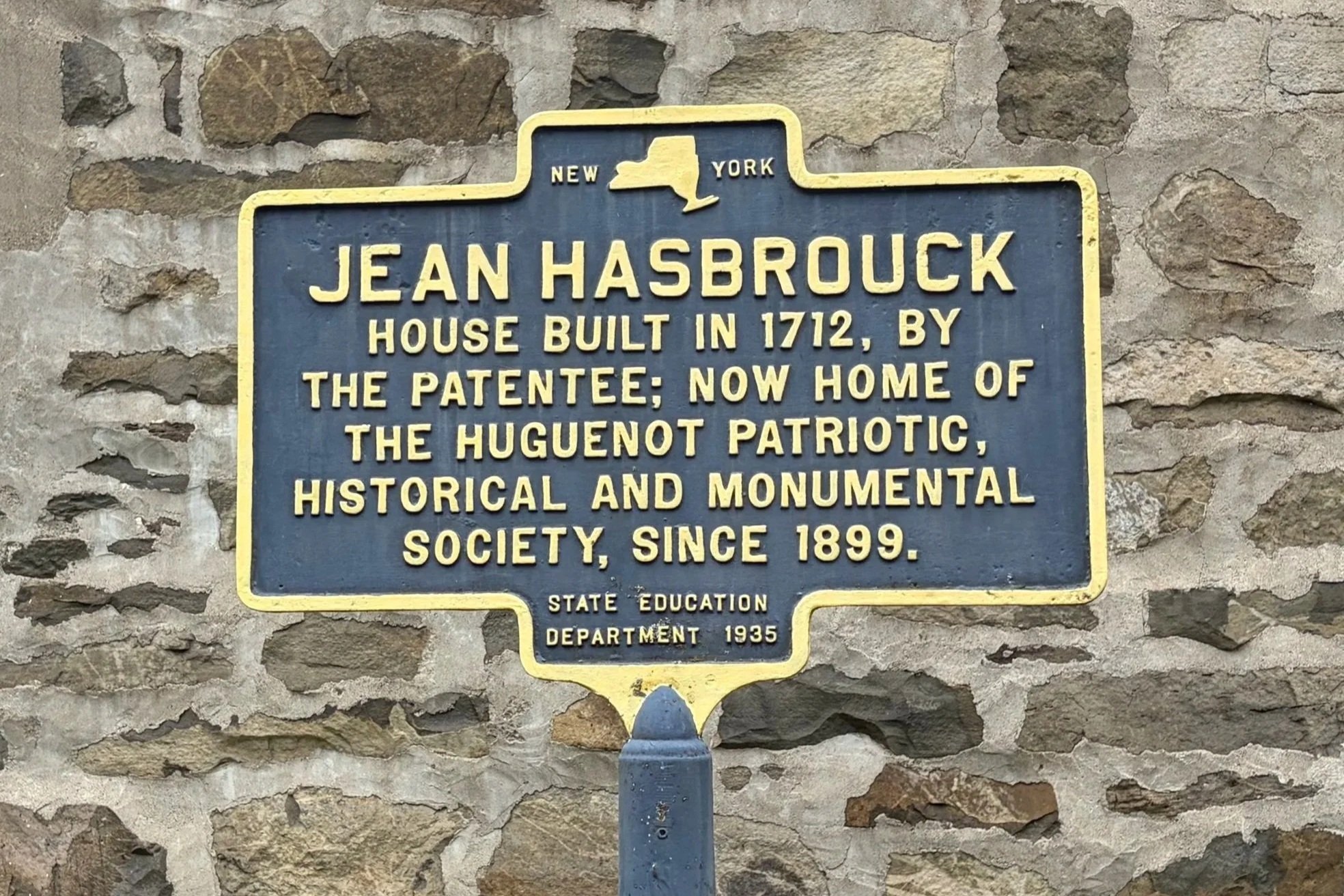
Jacob Hasbrouck House
Jacob Hasbrouck House
HOUSE BUILT IN 1712, BY THE PATENTEE; NOW HOME OF THE HUGUENOT PATRIOTIC, HISTORICAL, AND MONUMENTAL SOCIETY, SINCE 1899.
85% incorrect
-
the current house was built with trees cut down during Jean’s son Jacob’s ownership of this lot. Unusual among the houses along Huguenot Street, Jacob’s house was built in one phase, reflecting his wealth and status in the community.
-
The older of the two Hasbrouck patentees in New Paltz, Jean Hasbrouck (d. 1714) arrived in the Hudson Valley in 1673 with his wife, Anna Deyo. Two years later, his brother Abraham followed with his future-wife, Maria Deyo (Anna’s sister), and members of the Deyo family.
-
The Society was founded by descendants of the European colonizers to celebrate their history and preserve the historic buildings along Huguenot Street. Their motivations were grounded in a desire to set themselves apart from newly arrived European Americans, and the story told was neither fully accurate nor inclusive of the experiences of the local Indigenous people and the enslaved and free Black community.
-
The earliest recorded enslaved people residing in the house include James, Gerritt, Molly, and Hendrick. James and Hendrick likely contributed labor and skill in constructing Jacob’s house. Molly was given to Jean Hasbrouck’s daughter, Elizabeth, with the stipulation that if Molly had children, her first daughter would be taken from her at age one and given to Jean’s son, Jacob.
Enslaved people continued to appear in records for the family in the following decades, including Susan, Gin, Phillip, Henry, and numerous others.
The lumber used to construct this house was cut from the same grove of trees, in the same year, as the lumber used to construct the first part of Jacob’s cousin Daniel Hasbrouck’s house along Huguenot Street.
Investigations reveal the partial remains from an earlier, much smaller stone house built for Jean Hasbrouck within the southwest corner of the existing house. The front entrance of the earlier house faced south toward the Wallkill River.