
Historic Markers Revisited
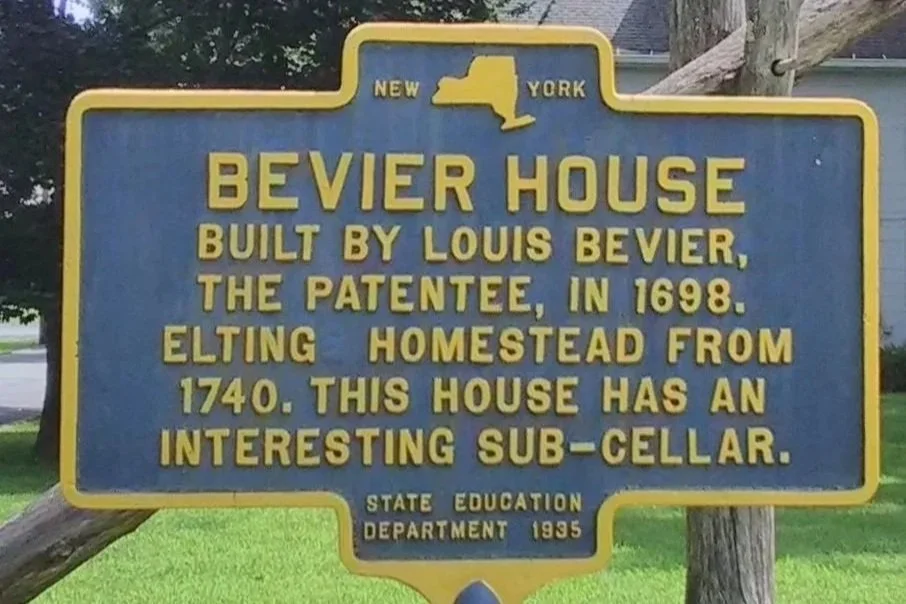
BEVIER HOUSE
84 Huguenot Street
BUILT BY LOUIS BEVIER, THE PATENTEE, IN 1698. ELTING HOMESTEAD FROM 1740. THIS HOUSE HAS AN INTERESTING SUB-CELLAR.
[33% incorrect]
-
Probably born near Lille in what is now France, Louis Bevier (c.1647–1720) relocated to die Pfalz [link to die Pfalz page] in Germany as a child. In 1673, he married Marie LeBlanc, a daughter from another French-speaking family who similarly left their homeland. The young couple, and their daughter, Maria, embarked for New York in 1675, possibly alongside members of the Hasbrouck family – sadly, young Maria would not survive the voyage.
-
The house was built in three phases over time, beginning with the west section (nearest to Huguenot Street) for Samuel Bevier around 1735. The middle section was built soon after. The final, east section was added by the Eltinge (also spelled Elting) family after the American Revolution. Thus, the house is today known as the Bevier-Elting House.
-
Roelof Eltinge (1687–1747) did in fact purchase a stone house (later demolished) just north of the Bevier homestead in 1735 from his DuBois in-laws.
-
Roelof Josiah Eltinge ran a store in the front room of the house before and after the Revolutionary War.
-
Located within the cellar of the middle section of the house, this crawlspace was likely used for food storage.
-
Both the Bevier and Eltinge families enslaved people of African descent. Molly, enslaved by Samuel Bevier, was named in his 1750 will. The 1755 Census of Slaves shows that Samuel enslaved two men and one woman over the age of 14 at that time. Saur, Jin, Jack, Sessor, Sam, Tam, Bett, Lon, John, Bram, Kloyntam, Isabel, Deyn, Robert, and Bett were enslaved here by the Eltinge family.
Positioning the gable end of the house to the street exemplifies urban Dutch architecture.
In 1776, shop owner Roelof Josiah Eltinge refused to accept Continental currency and was accused of being a Loyalist to the British Crown. His brother Solomon was found guilty of the same charge. Both men were imprisoned away from New Paltz for the duration of the American Revolution.
“Whatever it is, the way you tell your story online can make all the difference.”